
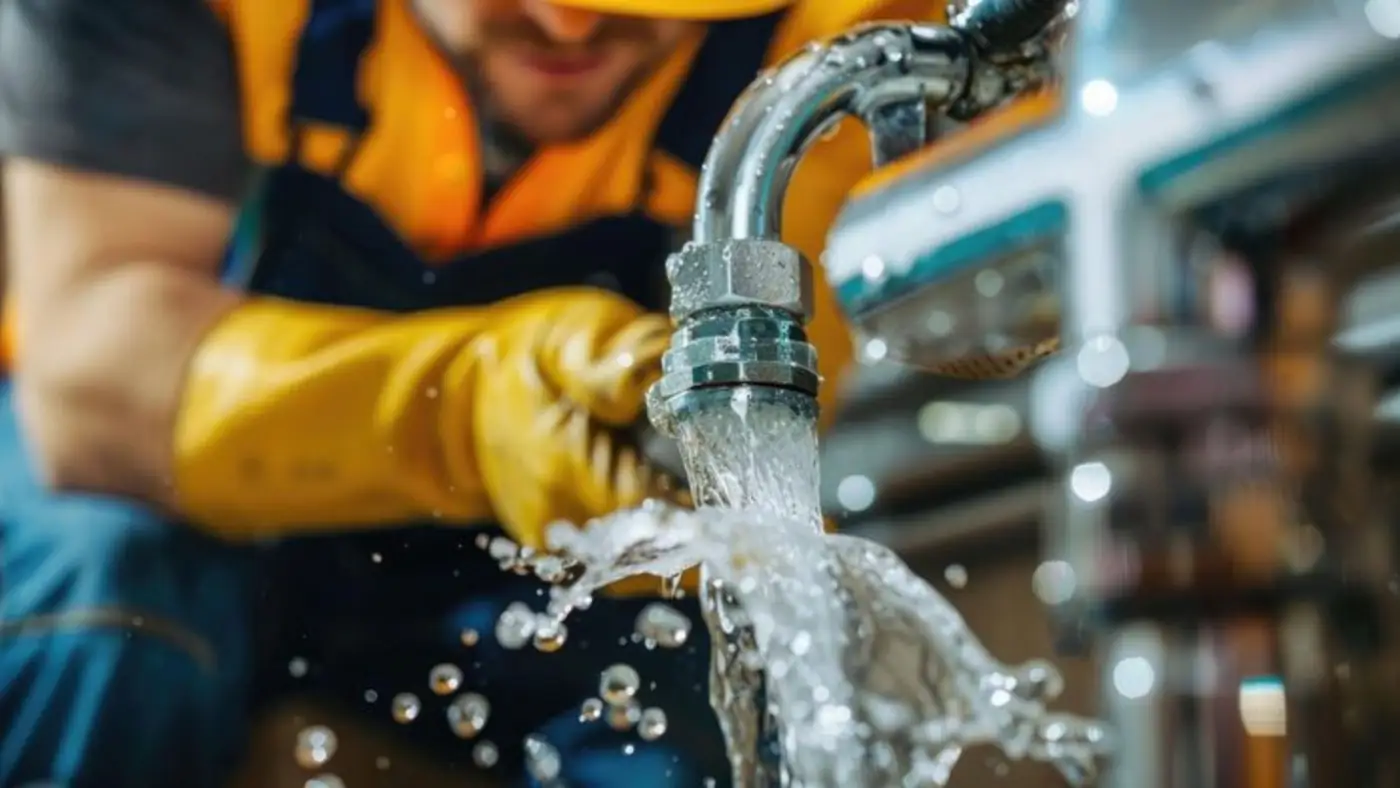
You hear a hiss, then a rush, and water is dripping through the kitchen ceiling or soaking the hallway carpet. A burst pipe is a supply line that has split under pressure, and it can release many gallons in minutes. The first hour decides how far the water travels.
Work in this order: stop the water, make the area electrically safe, protect what you can, document, then call for help. Do not start with a mop.
Stop the water first
Find the main shutoff and close it. In many homes it sits where the supply line enters the house, often near the water heater, in the garage, or at an outside wall. Turn a gate valve clockwise until it stops. A ball valve with a lever closes with a quarter turn.
If you cannot find it or it will not move, do not force a corroded valve with a wrench. Close the meter valve only if you know how and have the right tool. Otherwise call the plumber or the utility.
Which side of the meter is yours
The utility owns the line up to and including the meter. The pipe from the meter to your house, and every pipe inside, is the property owner's. A leak between the meter and your foundation is usually yours to repair, while a break in the street is the utility's.
If the break is clearly before the meter, call the utility. If you are unsure, a plumber can tell you in minutes.
Make the room electrically safe
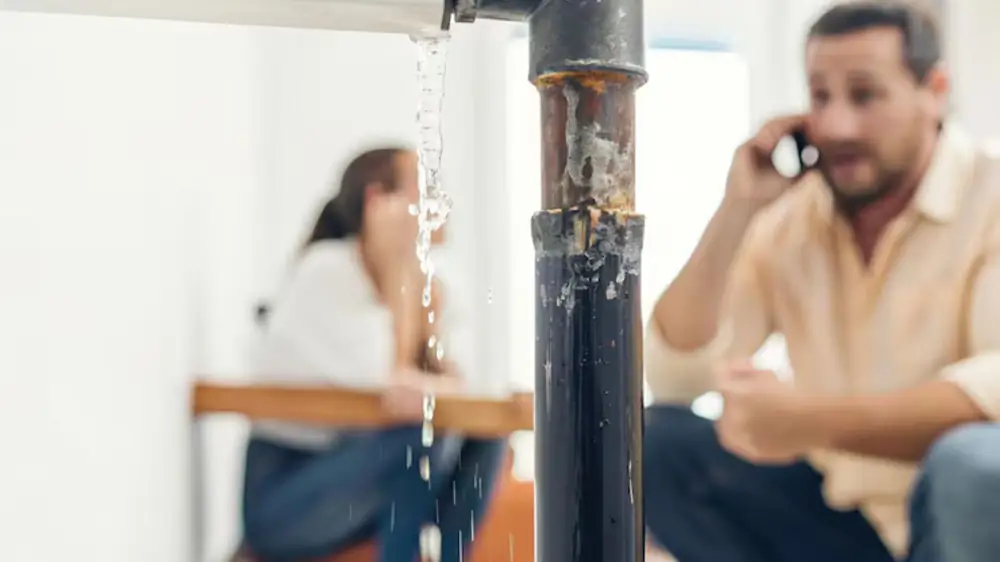
Water and electricity do not mix. If water is running down a wall with outlets, around a ceiling fixture, or near the electrical panel, treat it as live. Cut power at the breaker only if the panel is dry and you can reach it without stepping through water.
If the panel is wet or you smell burning, stay out and call 911 or the utility before calling us. Do not use a household vacuum on standing water. Do not touch light switches in a room where the ceiling is dripping.
Do not wade into wet rooms
Standing water near outlets, cords or appliances can carry current. Stay out until power is confirmed off.
Skip the household vacuum
A regular vacuum is not built for water. Use towels and a mop only on small, safe spills.
Do not force old valves
A corroded shutoff can snap and make the leak worse. Call a plumber if it will not turn.
Avoid ceiling pressure
A bulging ceiling holds water. Do not poke it unless a bucket is under it and the room is clear.
Burst line or slow drip
A burst line is loud, fast and obvious. A slow drip behind a wall can run for weeks before you see a stain. The difference matters for cost and for insurance, since sudden and accidental damage is often covered, while gradual leaks and neglect often are not. Check your policy and ask your insurer.
Signs of a slow leak include a musty smell, a spinning water meter with every tap closed, a soft baseboard or paint that bubbles. If the meter keeps spinning after you close the main, the leak may be underground between the meter and the house. That is a main-line failure on your side of the meter.
What to move and what to photograph
- Lift rugs, electronics, books and small furniture to a dry room.
- Place aluminum foil or wood blocks under furniture legs so stains do not wick up.
- Open cabinet doors under sinks and let air in.
- Photograph the source, the wet areas, the damaged items and the water meter reading.
- Keep damaged materials until your insurer has seen them, if it asks.
Take wide shots first, then close-ups with something for scale. Video works well too. Photos taken before cleanup begin are the strongest record of what the water did.
Water still spreading?
Call (818) 337-2642 any hour. We dispatch 24/7 and offer same-day response when available.
Drain the lines and open the taps
Close the main
Turn off the shutoff so no more water reaches the broken section.
Open the lowest tap
Open a faucet at the lowest point, such as a hose bib, to drain the pipes.
Open an upstairs tap
Open a high faucet too, so air enters and the lines drain faster.
Turn off the water heater
Shut off power or gas to the heater so it does not run dry while the lines are empty.
Leave the taps open until a plumber has repaired the pipe. Do not turn the main back on to test the repair yourself, because a failed joint will flood the room again.
Street main breaks and pipe bursts inside your walls are different jobs
Studio City has seen street-level main breaks. In 2026 an 8-inch cast-iron main burst on Coldwater Canyon Avenue near Woodbridge Street, flooded the roadway, and LADWP shut off water to roughly 40 to 60 customers while crews repaired it. In 2014 an 8-inch main broke on Halkirk Street, and LADWP said about 56,000 gallons escaped.
The consequence is simple. A street main break is the utility's job, so call LADWP and 311. Water inside your walls is yours to stop and dry. In 2014 the water reached yards and some homes on Halkirk and nearby Goodland Avenue, so after a main break near you, check your crawl space or garage for water even if the house looks dry.
When the break is in the main line
A main-line failure sits between the meter and the house. Signs include a wet patch in the yard, low pressure through the whole home, a meter that spins with every fixture off, or water pooling by the foundation. Slab leaks add warm spots on the floor.
These need a plumber who can locate and repair the line. Once the pipe is fixed, drying begins. Our water mitigation crews extract water, set air movers and dehumidifiers, and check moisture in the framing and subfloor.
In North Hollywood, where about three quarters of housing was renter-occupied in the 2000 census, tell the landlord right away so the building owner can send a plumber. Owners in Encino, where about 61.6 percent of housing was owner-occupied, usually arrange the repair themselves.
What happens after the leak is stopped
Water in drywall, carpet pad or insulation needs extraction and drying quickly. EPA says dry water-damaged areas and items within 24 to 48 hours to prevent mold growth. Drying commonly takes several days, depending on materials and how far the water spread.
Scope and price are explained before work starts. If the water came from a toilet supply or a sewage line, treat it differently and stay out, because that water is not clean.
Where do I call if a pipe bursts in the street instead of my house?
Call LADWP and 311. A street main break belongs to the utility, as with the Coldwater Canyon Avenue and Halkirk Street breaks. If water reaches your property, then call us.
Should I call a plumber or a restoration company first?
Call the plumber to fix the pipe and us to dry the structure. If you are unsure, call us at (818) 337-2642 and we will point you toward the right order.
Will insurance cover a burst pipe?
Sudden and accidental damage is often covered. Gradual leaks often are not. Check your policy and ask your insurer, because we cannot promise a claim outcome.
How long until mold can start?
EPA says to dry wet areas within 24 to 48 hours, and that mold usually will not grow if you do. After that window the risk rises.
Should I check my crawl space after a nearby main break?
Yes. In 2014 the Halkirk Street break sent water into yards and some homes. Look under the house and in the garage for standing water.